

Quick Answer: A cyber liability insurance application often slows down because the business is missing verified answers about data handling, access controls, backups, payment workflows, and prior incidents. A practical way to move forward is to gather input from leadership, IT, finance, and operations before starting so the application is more likely to be accurate the first time.
At Mad Insurance, this is where many businesses get stuck. They are ready for a quote, but the application quickly moves beyond basic company information and into questions that need input from leadership, IT, finance, or an outside technology provider.
Why Businesses Should Prepare Before Starting a Cyber Insurance Application
Cyber insurance applications help underwriters understand how a business operates, what information it handles, and where a cyber event could create financial loss. That is why the questions usually go well beyond revenue and industry. They often focus on access controls, backups, email security, vendor access, and prior incidents.
A common pattern is that a business expects the application to be simple, then realizes key answers sit with different people. This is where delays start. One unclear answer can trigger follow-up questions, and those follow-ups can slow quotes across more than one carrier.
If a business still needs broader context before working through application details, cyber insurance is a useful starting point. If the business is already preparing an application, organizing the facts usually matters more than reading more background material.
Quick Checklist: Information Commonly Requested on a Cyber Liability Insurance Application
Before getting into each item, here is the short version. Most cyber liability insurance applications ask for details in these areas:
- Business details and operations
- Revenue, employee count, and locations
- Types of sensitive information handled
- Payment processing and funds transfer exposure
- Cybersecurity controls and IT practices
- Backup, recovery, and incident response readiness
- Prior incidents, claims, or known events
- Third-party vendors and outsourced technology support
This checklist works best when the business uses it as a preparation tool rather than treating it like a formality. More complete answers up front can reduce delays later.
Business Details and Operations
Most applications start with standard business information such as legal name, entity type, website, physical locations, and a description of what the company does. That sounds straightforward, but the operational description matters more than many businesses expect.
Underwriters are trying to understand how the business uses technology in daily operations. A company that stores customer files, works in cloud platforms, invoices electronically, or gives employees remote access may have a different cyber profile than one with limited digital exposure. This is one reason cyber coverage fits into a broader protection strategy, much like the coverage areas discussed in small business insurance in Florida coverage areas.
Revenue, Employee Count, and Locations
Applications commonly ask for annual revenue, employee count, and where the business operates. These questions help frame the size and complexity of the risk. More employees, more devices, more logins, and more locations generally mean more moving parts to review.
This can become more involved when the workforce is spread across multiple offices or remote locations. If employees work from home, travel regularly, or log in from different places, the exposure is no longer limited to one office network.
Types of Sensitive Information Handled
Businesses are often asked what kinds of information they collect, store, access, or transmit. That can include customer contact details, employee records, payment information, health-related information, confidential documents, or proprietary business files.
This is where confusion can start. A business may say it does not store sensitive data, but its email system, file-sharing platform, or software vendors may still process that information somewhere in the workflow. The important distinction is not just what sits on a local server. It is what the business handles across its operations.
Payment Processing and Funds Transfer Exposure
Many applications ask about online payments, ACH activity, wire transfers, invoicing, and who approves payment changes. These questions relate to social engineering and funds transfer fraud exposure.
A common pattern is that businesses focus on breach-related questions and overlook payment controls. If staff can receive emailed payment instructions, update banking details, or move funds based on electronic requests, underwriters often want to know what approval steps are in place. Weak controls here can lead to closer review.
Cybersecurity Controls and IT Practices
This section is where many applications slow down. Carriers commonly ask about multi-factor authentication, endpoint protection, firewalls, patching practices, email filtering, encryption, and whether IT is handled internally or by an outside provider.
The key point here is simple: do not guess. A business owner may believe MFA is “on,” but the underwriting question is often where it is enabled. Email only is not the same as email, remote access, administrator accounts, and critical systems. This is a common issue during quoting. The business feels confident in the answer until the carrier asks for more detail, and then the application may need to be corrected.
Backup, Recovery, and Incident Response Readiness
Applications also ask whether backups exist, how often they run, whether they are tested, and whether the business has an incident response or recovery plan. These questions matter because a cyber event is not only about how an attack starts. It is also about how quickly operations can recover.
A common misunderstanding is thinking backups are enough on their own. Backups that are outdated, untested, or difficult to restore are more likely to lead to longer downtime when systems go down. That is why this section tends to matter in underwriting review.
Prior Incidents, Claims, or Known Events
Most applications ask about prior cyber incidents, past claims, ransomware events, phishing losses, privacy concerns, or any known issue that could lead to a claim. These are not minor questions. They help the carrier understand whether the business has unresolved exposure or a history of related problems.
This is where accuracy matters most. Incomplete or inconsistent disclosure can create bigger problems later than the original incident. If there has been an event, the business should be clear about what happened, what was affected, and what changed afterward.
Third-Party Vendors and Outsourced Technology Support
Many businesses rely on managed IT providers, cloud platforms, software vendors, payment processors, or outside consultants. Applications commonly ask who manages systems, who has access, and whether third parties handle sensitive information.
This is one of the most common blind spots in cyber applications. Businesses know they outsourced the work, but they do not always know who has administrative access, who monitors systems, or how vendor access is controlled. That gap can lead to slower answers and more follow-up from underwriting.
What Insurers May Look at More Closely During Underwriting
Not every question carries the same weight. Some items draw more attention because they connect directly to how cyber losses usually happen and how difficult recovery may be. If a business is moving from checklist stage to quote stage, the underwriting side of cyber liability insurance is usually easier when these details are already verified.
Multi-Factor Authentication and Access Controls
MFA and access controls are commonly reviewed closely because they relate directly to unauthorized access risk. Underwriters often want to know whether MFA is used for email, remote access, administrator accounts, and critical cloud systems.
If a business keeps getting follow-up questions in this area, the first answer may have been too broad. “Yes, we have MFA” is not always enough. The real issue is where it is enforced and who can still access systems without it.
Email Security and Phishing Exposure
Email remains a major entry point for fraud, credential theft, and payment scams. That is why applications often ask about filtering, employee training, login protections, and business processes tied to emailed requests.
This exposure can grow when the business relies heavily on email approvals for invoices, banking changes, or urgent internal requests. The concern is not only a technical breach. It is also operational disruption and money moving where it should not.
Backups and Ransomware Resilience
Backup questions are usually about more than whether copies exist. Underwriters may focus on separation, frequency, restore testing, and whether backups support actual recovery after ransomware or system failure.
A common pattern is that businesses answer “yes” to backups because the system runs automatically, then struggle when asked whether those backups have been tested recently. That distinction matters. A backup that has never been restored is different from a recovery process the business knows works.
Remote Access, Network Monitoring, and Vendor Access
Remote access tools, VPNs, network monitoring, and third-party access usually receive closer review because they create direct paths into business systems. The more people and vendors with elevated access, the more important it becomes to know how that access is controlled.
This is where problems can spread beyond one simple answer. A business might have secure office systems but loose remote access rules, shared credentials, or outside vendors with broad permissions. That setup tends to create more underwriting questions because the weak point is not obvious from the basic application alone.
If your business is running into any of these issues, the application likely needs more preparation before it goes out:
- You are not sure where MFA is actually enabled
- Your IT provider has the technical answers, but they have not been gathered yet
- Backup and restore details are unclear or outdated
- Vendor access and payment approval workflows are not documented clearly
At that stage, it usually makes sense to prepare the information before comparing carriers, because incomplete answers tend to slow every quote that follows.
Who Inside the Business May Need to Help Complete the Application
Cyber applications rarely sit with one person from start to finish. The questions usually pull information from different parts of the business, and the process often moves faster when that is recognized early.
Owner or Executive
The owner or executive usually handles business operations, overall revenue, growth plans, contracts, and prior incidents. This person also tends to be the final reviewer for disclosures and application accuracy.
If the business has experienced an incident before, leadership usually has the clearest view of what happened and what changed afterward. That context helps keep answers accurate instead of vague.
IT Lead or Managed Service Provider
The IT lead or outside managed service provider usually owns answers about MFA, backups, endpoint protection, patching, remote access, and monitoring tools. These details should come from current system knowledge, not assumptions.
This is another frequent delay point. The application may be nearly ready, but the technical section still needs confirmation.
Finance or Operations
Finance or operations often needs to answer questions about payment approvals, wire transfers, vendor changes, invoice workflows, and account controls. These are usually the people who know how funds move and where approval breakdowns could happen.
If the business has multiple people handling payments or vendor changes, that usually needs to be reflected clearly. Vague workflow language here tends to trigger more questions.
HR or Compliance
HR or compliance may help with employee training, onboarding and offboarding, internal policies, and documentation tied to access controls. These answers help show whether security practices are built into daily operations or handled informally.
That difference matters because access management problems often start when old permissions stay in place too long or employees are not trained consistently.
Common Mistakes That Can Slow Down Cyber Insurance Quotes
- Guessing on technical answers. This often leads to corrections later, which can slow quoting and create avoidable follow-up.
- Using outdated security information. Controls change over time. Old assumptions can lead to inaccurate applications.
- Overlooking remote access or vendor exposure. Businesses remember their office setup but forget who else can log in or manage systems.
- Waiting too late to gather internal input. This can turn a simple checklist into a rushed scramble across departments.
- Submitting inconsistent answers across carriers. Similar questions are often worded differently, but conflicting answers can still create problems.
A similar pattern shows up in other commercial lines when preparation is missing. The same issue is reflected in guides like this commercial property insurance quote checklist. The form itself is usually not the real issue. Missing information is.
How to Make the Application Process Smoother When Comparing Carriers
The most practical approach is to prepare one accurate set of internal answers before shopping the application around. That means confirming technical controls with IT, clarifying payment workflows with operations or finance, and organizing prior incident details before the first quote request goes out.
This is where independent-agency guidance can be useful. Different carriers may ask similar questions in different ways, and businesses usually get better comparisons when the underlying facts are organized first. As explained in how an independent insurance agency works, the value is not just getting access to multiple carriers. It is making those comparisons easier to evaluate.
If a business is reviewing several types of protection at once, it also helps to keep cyber within the larger picture of commercial insurance. That can help prevent one application issue from slowing other coverage decisions.
Key Takeaways
- Cyber insurance applications often slow down because key answers are not gathered before the process starts.
- The most important details often involve data handled, payment controls, MFA, backups, remote access, and prior incidents.
- Technical answers should be verified, not assumed.
- Multiple people inside the business usually need to contribute.
- Organized answers can lead to cleaner quote comparisons across carriers.
Conclusion
The real problem is usually not the cyber application itself. It is incomplete or unverified information, and that often leads to delays, conflicting answers, and more underwriting follow-up than the business expected.
When that happens, the quote process can drag out and the business may end up reacting to questions instead of reviewing clear options. That is why working with Mad Insurance can be a practical next step. Mad Insurance helps businesses organize what carriers are likely to ask for, compare options across multiple carriers, and move from application confusion to a cleaner quoting process.
If the application is already in front of you and the answers are scattered across departments, now is a good time to request a quote with Mad Insurance.
Company Approach
Mad Insurance approaches cyber applications the way business owners usually need them handled: clearly, directly, and with an understanding that different carriers ask similar questions in different ways. The goal is not to make the process sound more technical than it is. The goal is to help businesses gather the right information before small application gaps turn into larger quoting delays.
That matters most for businesses comparing multiple options. When answers are organized early, the comparison is cleaner, the underwriting conversation is more focused, and the business has a better path forward.
FAQ
What information is usually needed for a cyber liability insurance application?
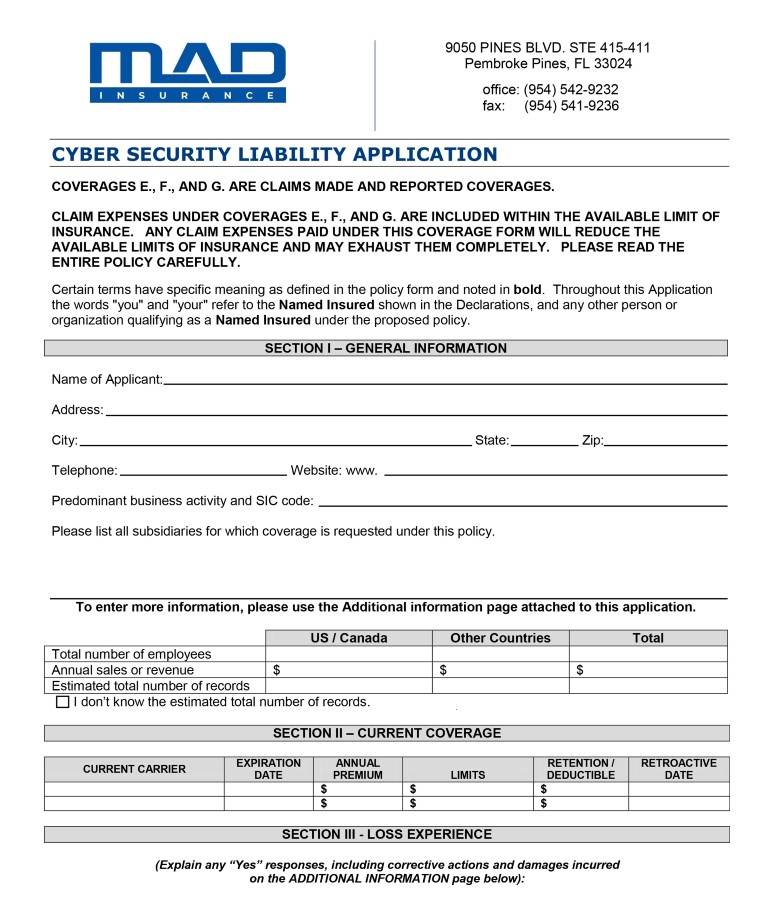
Most applications ask for business details, annual revenue, employee count, the types of sensitive information handled, payment and wire transfer processes, cybersecurity controls, backup and recovery practices, prior cyber incidents, and third-party vendor access.
The main point is that carriers are not just asking what the business does. They are trying to understand how technology is used, where loss could happen, and how disruptive a cyber event would be. A firm that stores client records in cloud systems may present a different profile than a company that mainly uses email and payment platforms, even if both are the same size.
Do small businesses need technical help to complete a cyber insurance application?
In many cases, yes. Small businesses can usually answer the company and operations sections, but technical sections often require input from an internal IT contact or outside managed service provider.
The reason is simple: questions about MFA, backup testing, endpoint protection, or remote access sound basic, but the answers depend on how systems are actually configured. A business owner may believe MFA is enabled everywhere because it is active on email, while the application may be asking whether it also protects admin access or remote logins. That distinction changes the accuracy of the application.
Why do cyber insurance applications ask about MFA, backups, and email security?
Those questions point to how cyber losses usually start and how difficult recovery becomes afterward. MFA relates to unauthorized access, backups relate to ransomware recovery and downtime, and email security relates to phishing, credential theft, and payment fraud.
What commonly gets misunderstood is that these are not isolated technical checkboxes. They are indicators of broader risk management. A business with backups that are never tested is in a very different position from one that knows recovery works, even though both might answer “yes” to having backups.
Can a business apply for cyber insurance if it does not know all of its security details yet?
A business can start gathering information, but it should not submit guessed or outdated technical answers. That is where avoidable problems begin.
For example, saying MFA is in place without confirming where it is enforced usually leads to follow-up once the carrier asks for specifics. If the missing detail affects access controls, backups, remote access, or incident history, it should be verified before submission.
Who should be involved in completing a cyber liability insurance application?
Most businesses need input from leadership, IT, finance or operations, and sometimes HR or compliance. The owner or executive usually handles business activity and prior incidents, IT handles technical controls, finance handles payment workflows, and HR or compliance may help with training and policy questions.
This matters because cyber applications are rarely owned by one department. When one person tries to complete the whole form alone, the process often slows down at the exact point where technical or payment-control details become necessary.
How can a business speed up the cyber insurance quote process?
The clearest way is to organize one accurate set of internal answers before requesting quotes. That includes verifying security controls with IT, clarifying payment approval steps, identifying what data the business handles, and collecting prior incident information in one place.
This becomes even more important when comparing multiple carriers because similar questions appear in different wording. The businesses that move faster usually are not the ones filling out forms more quickly. They are the ones that already know their answers and can keep them consistent.
Recent Comments